http://www.silicon-nutrition.info/Silicon_in_plants_and_soil.html
Silicon in plant and soil
Silicon protects plants from stress. Benefits of the nutrient especially become evident in adverse situations. While it is so difficult to prove the essentiality of silicon, experts often call the element 'beneficial' or even 'quasi-essential'.
As a rule of thumb cereals and other monocotyledonous crops rank as silicon accumulators and dicotyledonous plants are non-accumulators. On hydroponics however, several dicotyledonous pot plants, cut flowers and vegetable crops benefit from silicon fertilisation.
Soluble silicon in soil solution is at a pH range from 2 to 9 mainly present as orthosilicate. In this form silicon is an uncharged compound and is sensitive to leaching. Although sandy soils are silicon-rich, soluble silicon content is usually very low. Apart from rice products containing potting soils, growing media for pot plant and woody ornamentals are often poor in silicon.
Friday, April 6, 2012

Thursday, April 5, 2012
Sericulture Blogs
http://simoncharsley.blogspot.in/
SILK IN S INDIA
THIS NEW SITE IS FOR POSTINGS FOR 'SILK PRODUCTION IN SOUTH INDIA: AN EVALUATIVE HISTORY OF DEVELOPMENT SCHEMES, 1790S TO 1990S', SUPPORTED IN 2008-2010 BY THE BRITISH ACADEMY.
http://silkwormmori.blogspot.in/
THE SILKWORM
This blog covers the entire domain of sericulture. It is designed for providing a common platform for discussion between scientists, policy makers and students in the field. reproduction of content from this blog with due acknowledgement is encouraged.
http://silkwormmori.blogspot.in/2010/11/sericulture-in-cevennes-from-first.html
Sericulture in the Cévennes: from a first visit, autumn 2010
"Prof.Simon Charsley’s name evokes mixed feelings of respect, admiration and affection in our minds."
"Professor Charsley spent his prime years in India, and took up study on a topic which would have appeared rather unfashionable to the contemporary intelligentsia. His introduction to Indian Sericulture was quite accidental. In his own words”... I first came to India on a Younger Scientist exchange programme and found sericulture in Mysore. The enthusiasm that I met led me to a research project on the silk industry and how it worked in practice, and also to many good friends....” That was in the mid seventies- an era marked by rapid modernisation of Indian sericulture sector. The result of his intensive study of the rural livelihood was the classic “Culture and Sericulture (1982)” which still remains one of the most authentic documentations on Indian sericulture and probably the only one comparable to the work of Lefroy and Ansorge (1915), though different in perspective and purpose. Subsequently he wrote a number of papers practically covering every aspect of the industry viz.regulated markets, middlemen, technology, silk reeling etc. which still remain most valuble reference material for students of respective disciplines.
Indian sericulture is indebted to Prof. Charsley, primarily for bringing it into the contemporary developmental rhetoric. He was the first and (unfortunately) the last to address sericulture as a livestock industry. Probably its scope of being so designated is largely under-estimated by the academics and policy makers. Prof. Charsley argued that sericulture shares much with and historically has led the way for other livestock industries and advocated its importance in the developmental context. His view of sericulture- as a ‘study material’ in social and anthropological assessment of development in a society where people are separated not only by status, culture and life circumstances but also by religion caste and politics is still highly relevant. "
SILK IN S INDIA
THIS NEW SITE IS FOR POSTINGS FOR 'SILK PRODUCTION IN SOUTH INDIA: AN EVALUATIVE HISTORY OF DEVELOPMENT SCHEMES, 1790S TO 1990S', SUPPORTED IN 2008-2010 BY THE BRITISH ACADEMY.
http://silkwormmori.blogspot.in/
THE SILKWORM
This blog covers the entire domain of sericulture. It is designed for providing a common platform for discussion between scientists, policy makers and students in the field. reproduction of content from this blog with due acknowledgement is encouraged.
http://silkwormmori.blogspot.in/2010/11/sericulture-in-cevennes-from-first.html
Sericulture in the Cévennes: from a first visit, autumn 2010
"Prof.Simon Charsley’s name evokes mixed feelings of respect, admiration and affection in our minds."
"Professor Charsley spent his prime years in India, and took up study on a topic which would have appeared rather unfashionable to the contemporary intelligentsia. His introduction to Indian Sericulture was quite accidental. In his own words”... I first came to India on a Younger Scientist exchange programme and found sericulture in Mysore. The enthusiasm that I met led me to a research project on the silk industry and how it worked in practice, and also to many good friends....” That was in the mid seventies- an era marked by rapid modernisation of Indian sericulture sector. The result of his intensive study of the rural livelihood was the classic “Culture and Sericulture (1982)” which still remains one of the most authentic documentations on Indian sericulture and probably the only one comparable to the work of Lefroy and Ansorge (1915), though different in perspective and purpose. Subsequently he wrote a number of papers practically covering every aspect of the industry viz.regulated markets, middlemen, technology, silk reeling etc. which still remain most valuble reference material for students of respective disciplines.
Indian sericulture is indebted to Prof. Charsley, primarily for bringing it into the contemporary developmental rhetoric. He was the first and (unfortunately) the last to address sericulture as a livestock industry. Probably its scope of being so designated is largely under-estimated by the academics and policy makers. Prof. Charsley argued that sericulture shares much with and historically has led the way for other livestock industries and advocated its importance in the developmental context. His view of sericulture- as a ‘study material’ in social and anthropological assessment of development in a society where people are separated not only by status, culture and life circumstances but also by religion caste and politics is still highly relevant. "
Saturday, March 31, 2012
Micro Nutrient Foliar Sprays in UK
http://www.fwi.co.uk/Articles/30/03/2012/132191/Philip-Bradshaw-ponders-the-value-of-micro-nutrients.htm
Philip Bradshaw ponders the value of micro-nutrients
"To improve oilseed yields, we apply various micro nutrients through the growing season."
...
"It was while considering the use of foliar-applied nutrients that a thought occurred. ..
Are all the micro nutrient products the same quality, are some better than others? Do they differ in efficiency of uptake and how compatible are they?"
...
"However, I remain surprised that we do not as an industry consider the foliar nutrition products on offer , and how we apply them, in more depth."
Philip Bradshaw grows cereals, sugar beet and potatoes on 300 ha of fenland and other soil types at Flegcroft Farm, Whittlesey, Cambridgeshire.
Philip Bradshaw ponders the value of micro-nutrients
"To improve oilseed yields, we apply various micro nutrients through the growing season."
...
"It was while considering the use of foliar-applied nutrients that a thought occurred. ..
Are all the micro nutrient products the same quality, are some better than others? Do they differ in efficiency of uptake and how compatible are they?"
...
"However, I remain surprised that we do not as an industry consider the foliar nutrition products on offer , and how we apply them, in more depth."
Philip Bradshaw grows cereals, sugar beet and potatoes on 300 ha of fenland and other soil types at Flegcroft Farm, Whittlesey, Cambridgeshire.
Tuesday, December 13, 2011
Global Cropland
http://earthobservatory.nasa.gov/IOTD/view.php?id=76605&src=eoa-iotd
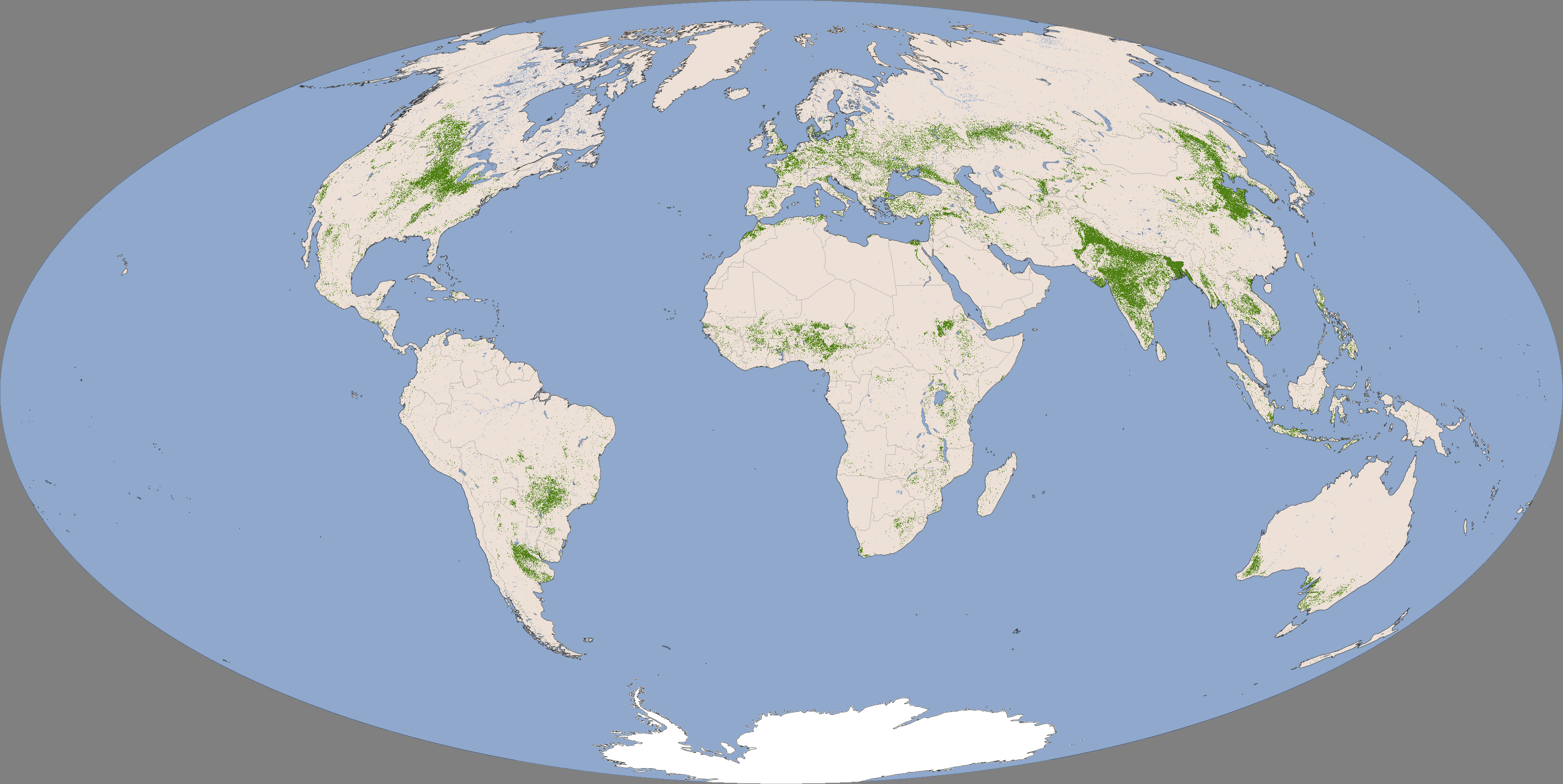

With seven billion people now living on Earth, the ever growing demand is putting unprecedented pressure on global resources—especially forests, water, and food. How can Earth’s resources be managed best to support so many people? One key is tracking the sum of what is available, and perhaps nothing is better suited to that task than satellites.
These two images show food production on both a global scale and a landscape scale. Made with data from the Moderate Resolution Imaging Spectroradiometer (MODIS), the top image shows where crops are grown throughout the world. Green areas are cropland, while tan areas are other types of land cover. In the last 40 years, cropland has increased by 70 percent to feed a growing population. Crops now cover about 40 percent of Earth’s land.
The lower image provides a landscape scale view of farming. The Landsat 7 satellite acquired the natural-color image on July 31, 2002. Bright green and gold fields stand out in stark contrast to the arid landscape along the Columbia River in western Washington. At this scale it is possible to gauge how healthy a crop is and estimate how much food it might produce. The United States Department of Agriculture uses such satellite data extensively to help determine where, when, and which crops are planted each year. They also use it to predict yields and to make commodity forecasts.
Measurements from the Landsat satellite also make it possible to tell how much water the crops consume in an arid environment. Such measurements are likely to become more important as demands on limited water resources increase. Currently, agriculture accounts for 85 percent of the world’s fresh water consumption.
“What we’ve done with satellites over the past 40 years is revolutionize how we monitor agriculture, forests, fresh water consumption, and other Earth resources required by the global population,” said James Irons, Landsat project scientist at NASA’s Goddard Space Flight Center. The worldwide pressure of feeding everyone requires a tool that has an impartial, world-wide view, making satellites a unique resource for scientists and policymakers alike.
NASA Earth Observatory image created by Jesse Allen and Robert Simmon, using Landsat data provided by theUnited States Geological Survey. Caption by Holli Riebeek, partly adapted from Using satellites to help the Earth sustain seven billion people.
Sunday, August 7, 2011
Silicon in Agriculture - Brazil - Sifol
Sifol
Plant Silicon
Product contains a high concentration of Silicon micro-nutrient, offering great benefits to agriculture, such as:
- Increase in productivity;
- Formation of physical barrier;
- Prevention or increase of plant resistance to toxic elements and salinity;
- Improve of photosynthesis rate;
- Increase of structural rigidity of tissues;
- Improve of plant's architecture by accumulating silicon in the cuticle, avoiding lodging;
- Regulation of plant's water loss by transpiration.
Silicon in Agriculture - Brazil
http://www.diatom.com.br/en-US/news/item/silicon-and-plant-s-resistance-to-pathogenic-fungus-attacks
Source: Embrapa
Article: Silicon and plant's resistance to pathogenic fungus attacks
Article by agronomist Oscar Fontão Lima Filho (Embrapa) talks about the importance of silicon to combat pathogenic fungi.
3342010-03-03T12:34:00-03:00America/Sao_PauloMarch2010Wed, 03 Mar 2010 12:34:00 -030003pm31Source: Embrapa
The benefits of adding plant ashes and animal manure to the soil to increase productivity has been known by farmers for thousands of years. This and a number of other products processed by men – in the form of fertilizers and soil acidity corrective – are sources of the plant nutrients, that is, mineral elements considered essential for plants to grow and to complete their life circle, playing several vital roles in plant metabolism.
The lack or excess of one or more of this minerals affects not only growth and productivity, but may also have an impact on plants resistance or tolerance to diseases and plagues. Resistance is basically determined by the ability the host has to limit penetration, development and/or reproduction of the invading agent. Tolerance, on the other hand, is characterized by the plant's ability to keep growing in a satisfactory way, while being infected or attacked by plague. Even being genetically controlled, resistance and tolerance are highly influenced by environmental factors. Among these, we highlight the mineral nutrition of the plant, whose soil fertility can be manipulated by means of fertilization and acidity correction.
Science has already demonstrated the involvement of silicon in several structural, physiologic and biochemical aspects of plants' lives, with very diverse roles. Silicon plays an important role in plant-environment relations, as it can provide culture with better conditions to resist climatic, edaphic and biological adversities, leading to an increase in production volume and quality. Stresses caused by extreme temperatures, short summers and heavy or toxic metals, for instance, can have its effects reduced by the use of silicon. One of the most important beneficial effects is silicon ability to reduce plants susceptibility to diseases caused by fungus.
Plants resistance to diseases can be increased by forming mechanical barriers and/or by changing the plant's chemical responses to the parasite attack, thus increasing the synthesis of toxins that can act inhibiting or repelling substances. Mechanical barriers include changes in anatomy, such as thicker epidermic cells and a higher degree of lignification and/or silicification (silicon impregnation). The amorphous silica located in the cell wall has a marked effect on the cellular wall physical properties. When it is accumulated in the cells of the epidermal layer, silicon can be a stable physical barrier to the penetration of some fungus, specially in grass. In this aspect, the role of silicon incorporated to the cellular wall is similar to that of the lignin – which is a structural component resistant to compression.
Besides the physical barrier, due to the accumulation in the epidermis of leaves, silicon also activates genes involved in the production of secondary compounds of metabolism, such as Polyphenols, and enzymes related to plants' defense mechanisms. This way, the increase of silicon in plant tissues increases plant's resistance to pathogenic fungus attack, due to the supplemental production of toxins that can act as substances inhibiting the pathogenic. Some examples of diseases which find resistance of the host with silicon supplementation include rice blast fungus, diaporthe sojae in soy, Powdery mildew in wheat, soy, barley, cucumber and tomato, Rhizoctoniose in rice and sorghum , cercospora beticola in coffee trees, among others.
The technology based on the use of silicon is clean and sustainable, with a great potential to reduce the use of agrochemical and increase productivity through a more balanced and physiologically more efficient nutrition, which means more productive and vigorous plants, with less diseases.
Oscar Fontão de Lima Filho
Click here to access more articles about the benefits of silicon to agriculture
Saturday, July 2, 2011
Silica in Agriculture
Agriculture: results 
There is a growing recognition about the importance of silicon for plants.
Nowadays silicates are used as fertilizers.
But much more research is needed.
The use of silicates highlights the importance of silicon for life e.g. plants.
For agriculture, the relevant silicon compounds are:
- silicates
- silicic acid
Silicates are used to improve the structure and fertility of the soil.
Silicates can compensate for acid soils, for salt, for access of aluminium and iron.
But moreover, silicates are the source for silicic acid being the silicon key molecule to optimize metabolism, plant growth and optimal yield.
The transformation to silicic acid is a complicated (and limited) process.
And the (ortho-)silicic acid molecule is very unstable, so only (very) limited quantities are found in rivers, water and soil.
Silicic acid is absorbed by organisms like plants and animals.
In plants the effects of (bioavailable) silicic acid are more resistance of roots, stem and leaves, improved metabolism, optimal growth and high yields with e.g. stronger fruits or grains.
Subscribe to:
Posts (Atom)
